


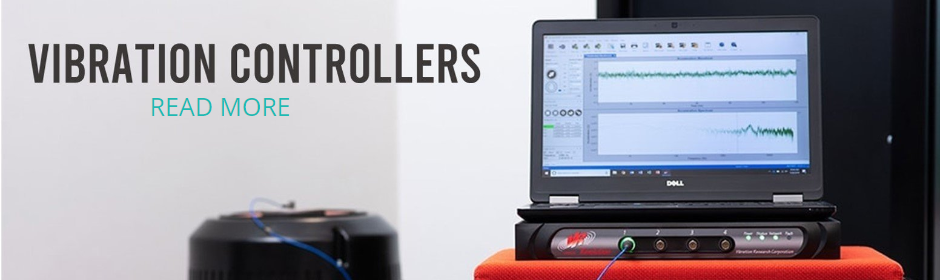
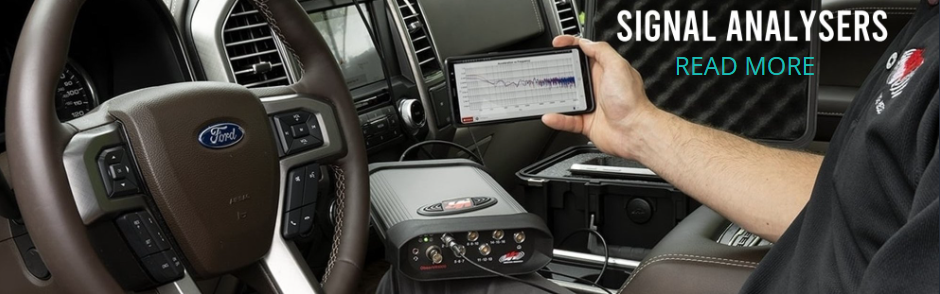
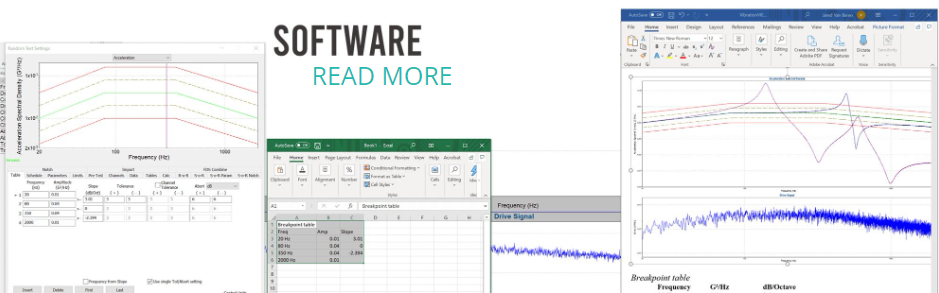
Vibration Research designs and manufactures vibration control systems and data acquisition systems for vibration testing on electrodynamic and servohydraulic shakers. Since 1995, VR has become a pioneer in the industry and the leader in vibration control and data acquisition. Advanced hardware capabilities and software support combined with powerful, user friendly software make Vibration Research controllers the premier choice of testing labs around the globe.
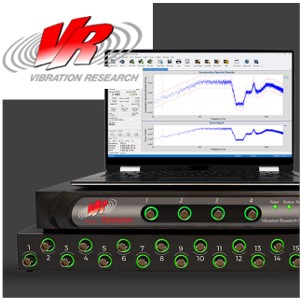
A vibration controller is a sophisticated electronic device used in vibration testing and control applications. It is designed to generate and control mechanical vibrations in various testing setups, ensuring precise and repeatable vibration conditions for research, product development, and quality assurance purposes.
Vibration controllers use closed-loop control systems to maintain a desired vibration profile or waveform. They measure the actual vibration response using sensors and compare it with the target waveform. The controller adjusts the excitation signal sent to the shaker or actuator to match the desired vibration, achieving accurate and consistent testing conditions.
A typical vibration controller consists of a hardware interface to connect with the shaker or actuator, input/output channels for sensors and external devices, a digital signal processor (DSP) for real-time data processing, and software for setting up tests, analyzing data, and generating reports.
There are various types of vibration controllers, including single-axis controllers for uniaxial testing, multi-axis controllers for simultaneous multi-axis testing, and random vibration controllers for reproducing real-world vibrations.
Vibration controllers offer several advantages, such as precise control over test conditions, repeatability of test results, reduced test time, enhanced safety for test specimens, and the ability to simulate real-world environmental conditions accurately.
Yes, advanced vibration controllers can replicate complex vibration profiles, including random, sine, shock, and swept-sine vibrations, allowing accurate simulation of real-world operating conditions.
Accelerometers, strain gauges, displacement sensors, and other transducers are commonly used with vibration controllers to measure and provide feedback on the actual vibration response of the test specimen.
Yes, vibration controllers can be integrated with environmental chambers, acoustic test systems and other test equipment for comprehensive multidisciplinary testing.
Yes, vibration controllers can be integrated with environmental chambers, acoustic test systems, and other testing equipment to conduct comprehensive multi-disciplinary tests.